The precursor to today’s Lakehead University in Thunder Bay, Ontario was Lakehead Technical Institute, established in 1946 in response to urgent need for higher education in the province’s northwest region. Lakehead became a university through royal assent in 1965 with Senator Norman McLeod Paterson as fist chancellor.

Hugging a small lake among the deciduous trees of the boreal forest, Lakehead’s Port Arthur campus is an eclectic series of variations on the core themes of modernism. This situation arose from a combination of budgetary constraints and a university policy to invite both local and national architects to design its buildings individually. While the result may lack coherence, it however offers what Lakehead art history professor Patricia Vervoort calls a “microcosm” of Canadian mid-century architecture.
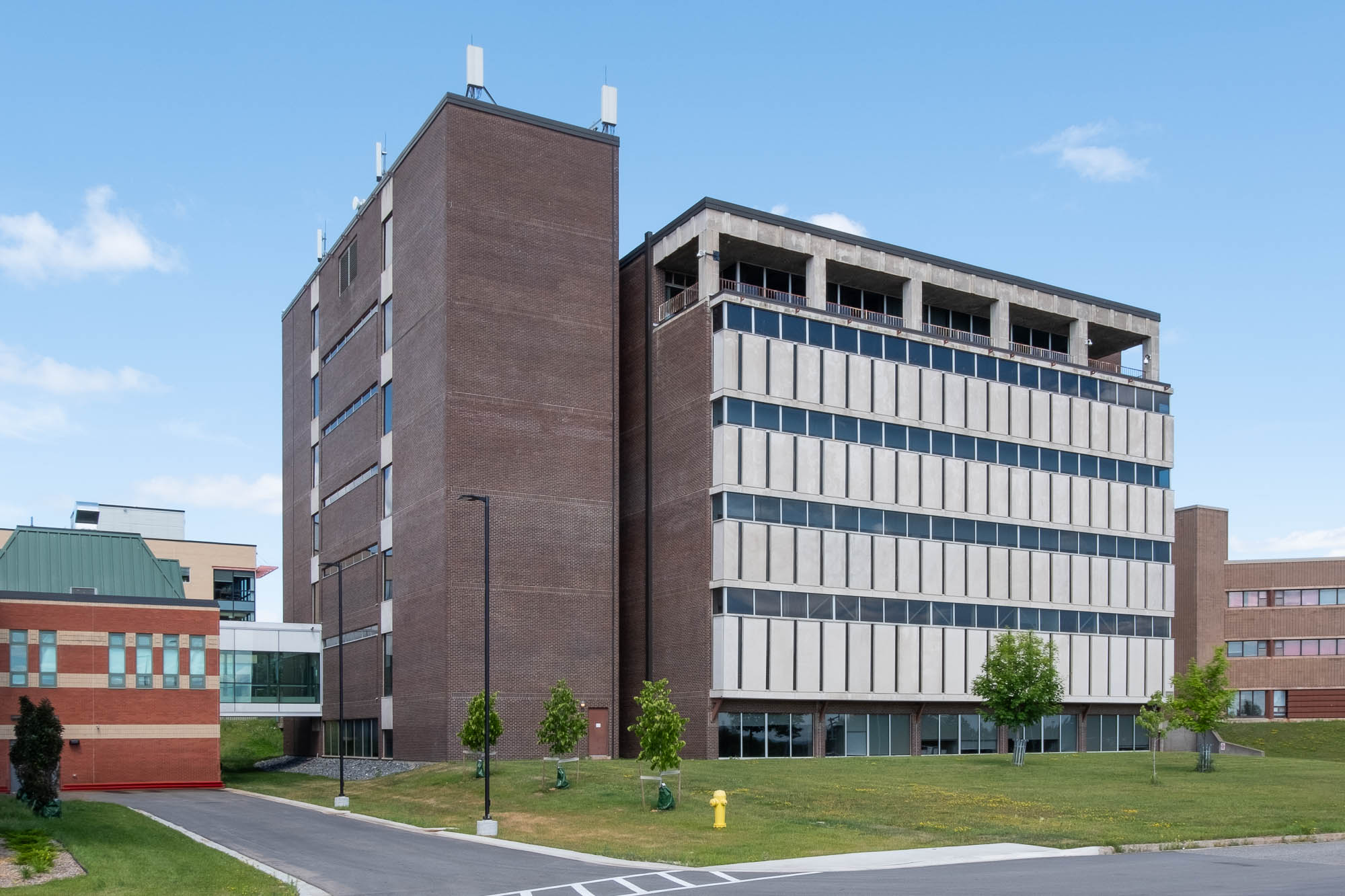
The library was built during the second phase of the campus development. Its design is the fruit of the collaboration of local firm Mickelson, Fraser & Haywood with Green Blankstein Russel of Winnipeg. The first two floors were built in 1963-65 followed by three additional storeys in 1966-67. Further room for expansion was built in the stairwell and services block, which could accommodate a second identical library wing. Despite being then the tallest building on campus, the facade emphasizes horizontal elements, perhaps in an effort not to overwhelm existing structures.

In 1980, the library was named the Chancellor Paterson Library in honour of Lakehead’s first university chancellor.
The images shown here date from a brief visit in July 2019.
References
Content note
You might also like