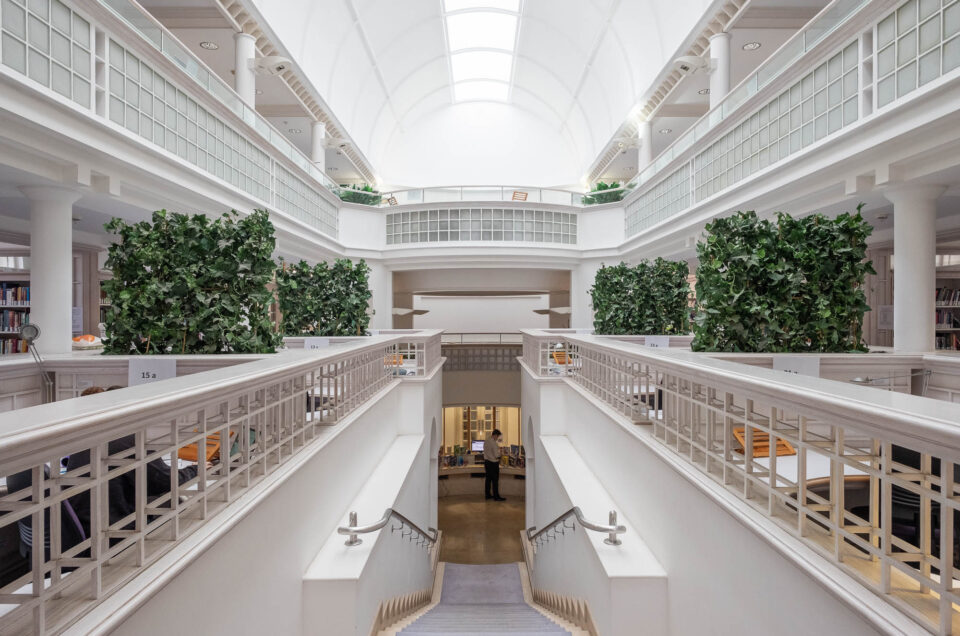
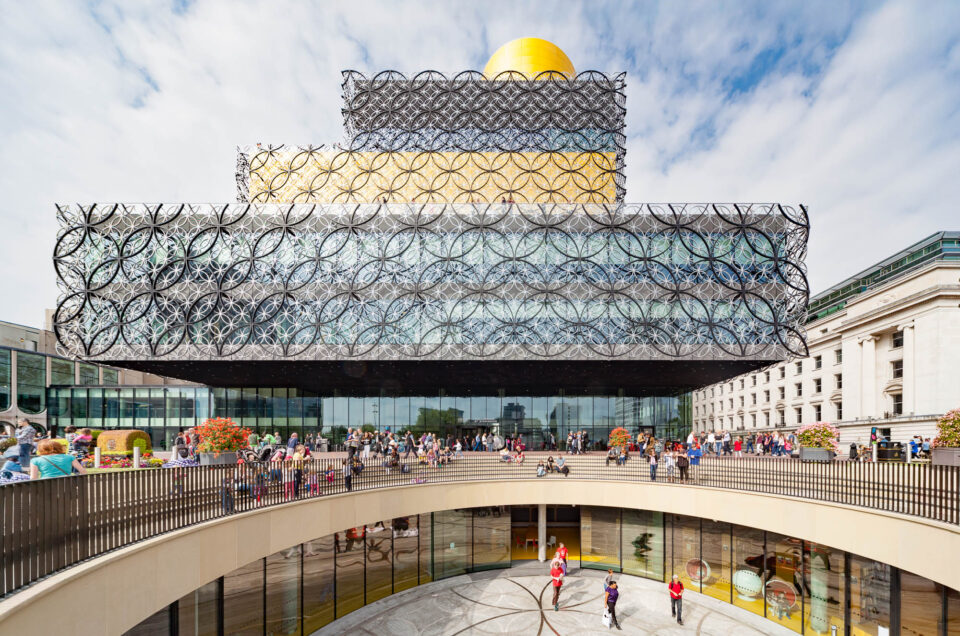
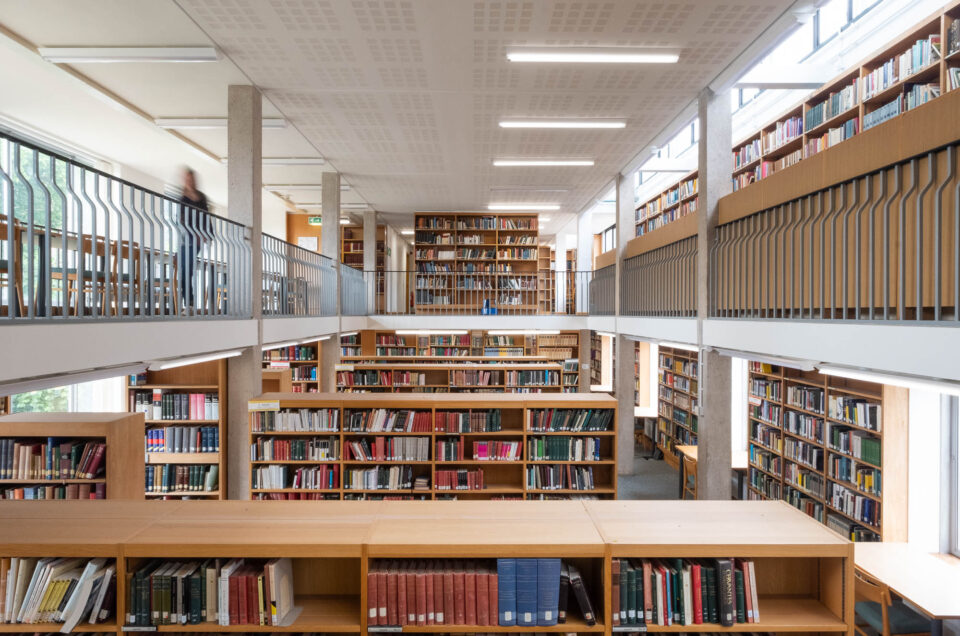
Architecture professor and critic Roger Stonehouse [1] likens the British Library as one of the “ocean liners” docked on Euston Road in London, together with major train stations King’s Cross, St Pancras and Euston. The journey for that particular ship was definitely not smooth sailing. Indeed, between the first plan to build a new British Museum Library in 1962 to the opening of the British Library in 1997, this project had to weather the political vagaries, budget cuts and backtracking of ten (!) changes in government. Its architect, Sir Colin St John Wilson, refers to it as his “Thirty Years War”.
When Wilson was first tasked with designing a new library, together with his then partner and mentor Sir Leslie Martin, the British Library as an institution did not even exist. The roles one associates with a national library were then shared between the British Museum Library, which maintained legal deposit, the British National Bibliography and the National Lending Library for Science and Technology at Boston Spa.

The star of this constellation was the Round Reading Room at the British Museum designed by Sydney Smirke and opened in 1857, which today remains sadly closed and can only been seen from the outside from within the museum’s Great Court. As wonderful as the space may be, it was woefully inadequate as a long-term storage facility, both because shelving space was severely limited and because of poor environmental conditions. External locations for storage and book lending were added over time to address these limitations, but the core issue remained that the bibliographical mandate always remained second to the other priorities of the British Museum. In 1971, a white paper finally called the government to action and recommended the creation of a true national library and in 1972 the British Library was finally established.
Through this birthing process and as the mandate shifted, Wilson kept reworking his proposal for a new library. Now that the link with the British Museum was severed, initial plans to build the library on the museum’s site in Bloomsbury were abandoned in favour of the site of the former Somerstown Goods Yard next to St Pancras station, which was purchased in 1976. The election of Margaret Thatcher and the Conservatives in 1979 however ground the project to a screeching halt by ordering a review of all government spending. What follows is a decades-long exercise in procrastination and shifting of responsibilities, through which the British Library project miraculously stayed afloat until financial approval to start construction was secured in 1987 and shovels finally got into the ground. In 1997, the first reading room opened. The library was officially inaugurated on June 25, 1998 and in 1999 the last section of the building, the science reading room, was completed.

The long delay between initial plans and construction led to a radical and quite fortuitous change, however. Drawn before the computer age, the first designs envisioned a vast catalogue hall at the heart of the library. By the time of construction, however, libraries were fully embracing computerized catalogues and the need for a vast array of card catalogue cabinets had vanished. Wilson seized this “marvellous change in circumstances” to re-purpose the space thus vacated to install the King’s Library [3]. Originally the personal collection of King George III, it was bequeathed to the British Museum in 1823 under the condition that it be kept in a separate repository and visible to the public.
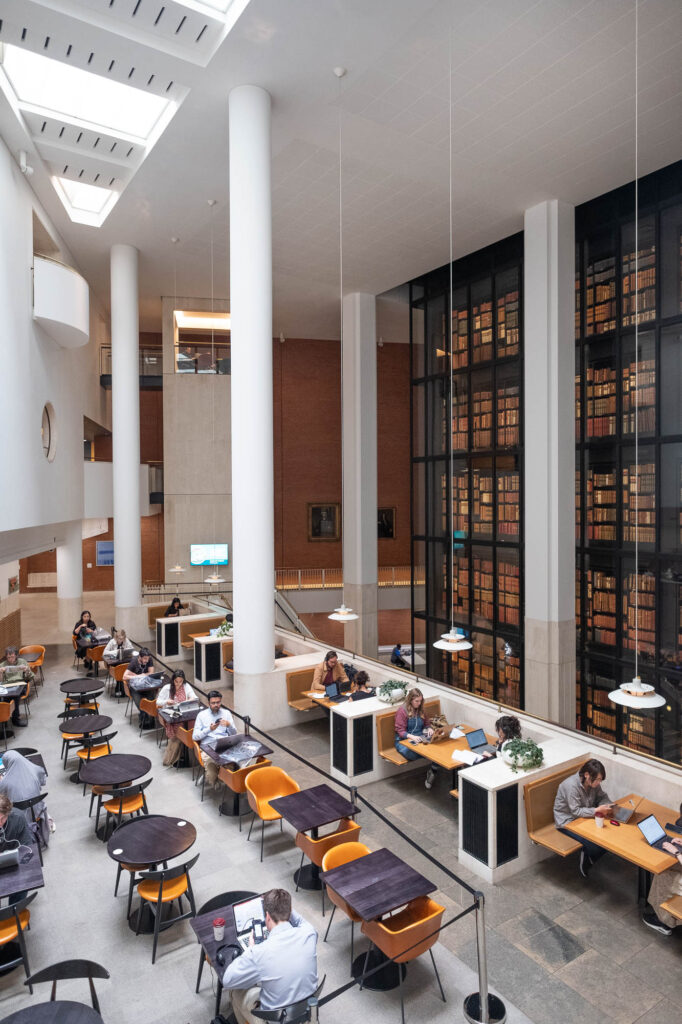
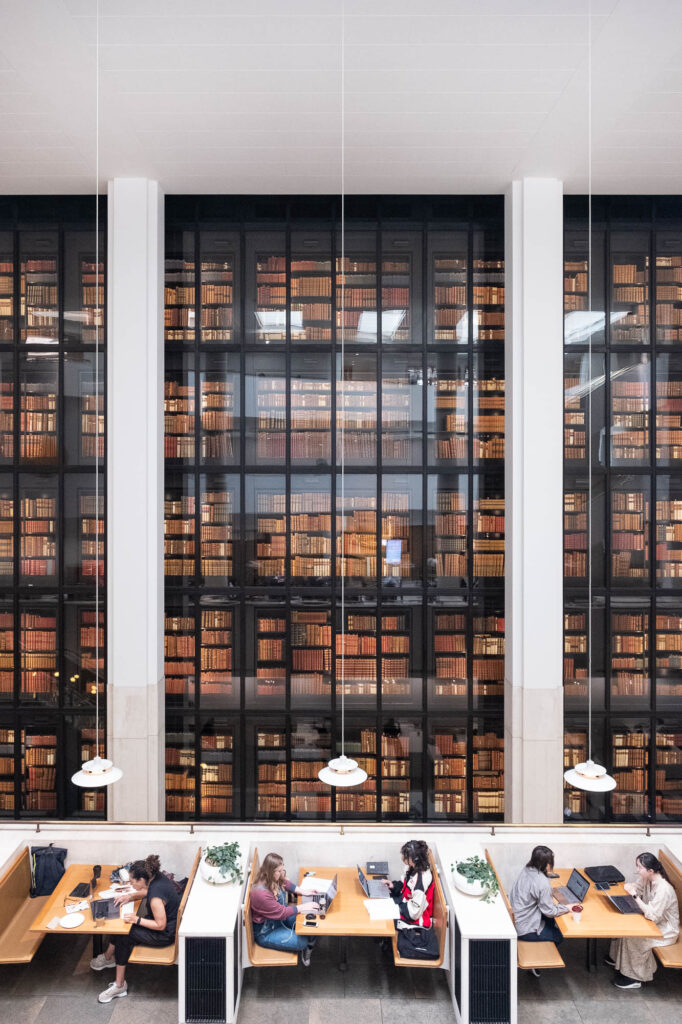
Inspired by Gordon Bunshaft’s Beinecke Rare Book Library at Yale University, Wilson built a dark steel and glass box to display this foundational collection. This fascinating object also recalls the Mecca’s Kaaba, an impression heightened by its central location; readers must past around it to reach all collections and reading rooms that radiate from there. It also functions as a clever representation of an otherwise invisible part of the library, the four levels of underground book storage that emerge here from the ground.
The King’s Library Tower, as it’s formally known, also contains the collection of politician and bibliophile Thomas Grenville.

The British Library is also remarkable in how busy it is. Its generous access policies (the building is open every day and most the spaces are open to casual visitors without the need for registration) and central location next to three major transit hubs certainly contribute to its success. The “quiet architecture” that characterizes Wilson’s work however plays a role there too. The roof over the main entrance gradually steps down to a non-threatening, human-sized one-story facade on the library’s forecourt. Once past the doors, visitors are greeted by a generous, light-filled atrium where the exterior brick walls and paving gradually make room for the marble and white walls of the interior. This avoidance of a massive street presence imposing respect is more inviting and is rather rare in national institutions.

Wilson was reportedly a great admirer of Scandinavian architects such as Alvar Aalto and Gunnar Asplund, and this influence is particularly visible in the entrance hall, where indirect light softly bathes the room thanks to the ceiling’s design.

References
- Stonehouse, R. & Stromberg, G. (2004). The architecture of the British Library at St Pancras. Spon.
- Donnelly, F. D. (1981). The British Library: Phenomenon of the Seventies or Prototype of National Library Planning. The Journal of Library History (1974-1987), 16(2), 380–393.
- Sommer, J. & Gamper, U. (2022). A Marvellous Change in Circumstances. The Modernist, 43, 12–16.
- Day, A. E. (1998). Inside the British Library. London : Library Association Pub.
- Architecture and design of the British Library. The British Library. Retrieved November 17, 2022
Content note
You might also like